BATCHING WITH CHAIN OF CUSTODY
Scaling Operations Without Losing Control
When Efficiency Breaks Trust: Why Batching Needs a Chain of Custody.
Batching is supposed to make operations smoother. Fewer handoffs. Lower costs. Faster throughput.
But somewhere between “we’ll batch this to be efficient” and “where did this inventory come from?” things quietly fall apart.
Teams start losing visibility. Errors become harder to trace. Customers ask questions no one can confidently answer. And when something goes wrong, everyone points at the batch - because no one can point at a person, system, or step.
In the world of logistics, manufacturing, and high-stakes data handling, we often find ourselves caught between two competing goals: Efficiency (doing things fast and in bulk) and Accountability (knowing exactly who touched what, and when).
When we talk about Batching with Chain of Custody (CoC), we’re essentially trying to bridge that gap. It’s the art of grouping items together to save time without losing the "paper trail" that keeps our auditors happy and our processes secure.
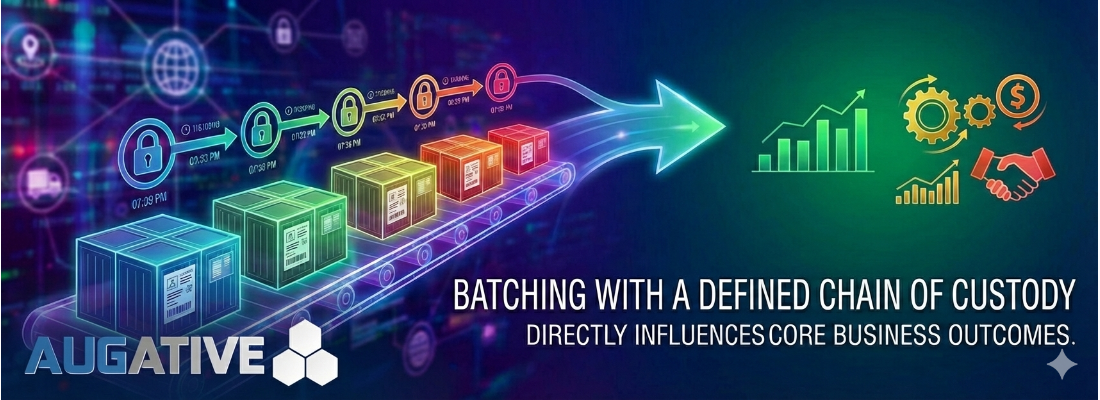
Batching with a defined chain of custody directly influences core business outcomes.
At a strategic level, it improves:
- Inventory accuracy and reconciliation rates
- Shrinkage and loss metrics
- Fulfillment SLAs and cycle times
- Audit readiness and compliance confidence
- Speed of dispute resolution with customers and partners
Tactically, teams gain:
- Clear ownership at every handoff
- Faster root-cause analysis when issues arise
- Reduced rework, firefighting, and exception handling
- Safer scaling across locations, systems, and third parties
Without custody, batching hides problems. With custody, batching exposes and resolves them early.
The Batching Process
Batching with chain of custody is the practice of grouping items, transactions, or work units while preserving explicit ownership, state, and traceability throughout the batch lifecycle.
A batch is no longer a black box. It becomes a managed entity with:
- Defined entry criteria
- Assigned responsibility
- Documented state transitions
- Verifiable outcomes
Illustrative Example
Consider a warehouse batching returned goods for inspection:
- Without custody, a mixed pallet arrives, sits unprocessed, and later shows discrepancies no one can explain.
- With custody, the batch is created, assigned to a team, transferred with confirmation, inspected against expectations, and formally closed.
Same operational step. Radically different control.
High-Level Process Flow
- Batch Creation – Items are grouped with rules and metadata
- Custody Assignment – A team, system, or partner is accountable
- State Transitions – Every handoff update status and ownership
- Validation & Controls – Checks protect integrity at each stage
- Batch Closure – Reconciliation confirms expected vs. actual
Nothing moves without an owner.
This approach is especially valuable for:
- Operations and supply chain leaders
- Warehouse and logistics managers
- Inventory control and finance teams
- Businesses handling regulated, high-value, or perishable goods
- Organizations scaling across locations or outsourcing fulfillment
You’ve likely reached the tipping point if:
- Inventory discrepancies are treated as “normal”
- Multiple teams or vendors touch the same batch
- Audits are stressful or risky
- Growth has outpaced process clarity
- Investigations start with “we’re not sure where it broke down”
These are not people problems - they’re custody problems.
Risks Introduced by Batching - and How to Mitigate Them
Inventory Visibility Risk
- Risk: Batches mask item-level location and status.
- Mitigation: Attach ownership, timestamps, and state data to every batch movement.
Stock Damage or Loss Risk
- Risk: Damage occurs, but responsibility is unclear.
- Mitigation: Enforce custody handoffs with acceptance checks and confirmations.
Pricing and Valuation Risk
- Risk: Mixed-condition or mixed-value items distort inventory valuation.
- Mitigation: Segment batches by pricing logic or apply valuation rules at custody checkpoints.
Risk doesn’t disappear - but it becomes visible, measurable, and controllable.
Conclusion
Batching is a powerful lever for scale - but without a clear chain of custody, it quietly trades short-term efficiency for long-term risk. What starts as a way to move faster can become a source of confusion, finger-pointing, and hidden cost.
The shift isn’t about adding bureaucracy or slowing teams down. It’s about making ownership visible, decisions traceable, and outcomes explainable. When every batch has a history, a state, and a clear owner, problems surface earlier, teams collaborate better, and trust - internally and externally - stops eroding.
As operations grow more complex, control doesn’t come from tighter oversight. It comes from better-designed processes. Batching with chain of custody is one of those designs: simple in concept, powerful in impact, and essential for any organization that wants to scale without losing control.
Put Chain of Custody into Action with Augative
Batching with chain of custody shouldn’t live in spreadsheets, workarounds, or tribal knowledge. With Augative, it becomes a built-in operational advantage.
Augative helps you manage unique products in separate, traceable batches that move seamlessly through your entire business - from goods receipts and stock transfers to production, deliveries, and every process that impacts inventory.
With Augative, you can:
- Improve safety and compliance through full inventory visibility
- Track expiration dates and automatically select batches based on expiry rules
- Automate batch sequencing and follow the chain of custody from receipt through production, sales, and delivery notes
- Create faster, more cost-effective recall processes when issues arise
- Manage product quality in smaller, controlled batches
- Reduce accounting errors while tracking costs and profitability per batch
If batching is critical to your operation, visibility and control shouldn’t be optional.
👉 See how Augative brings chain of custody to life in your business.
Book a demo today: https://augative.com/Booking/BookADemo